

How AI Agents Work in Travel and Why Every OTA Needs Agentic AI
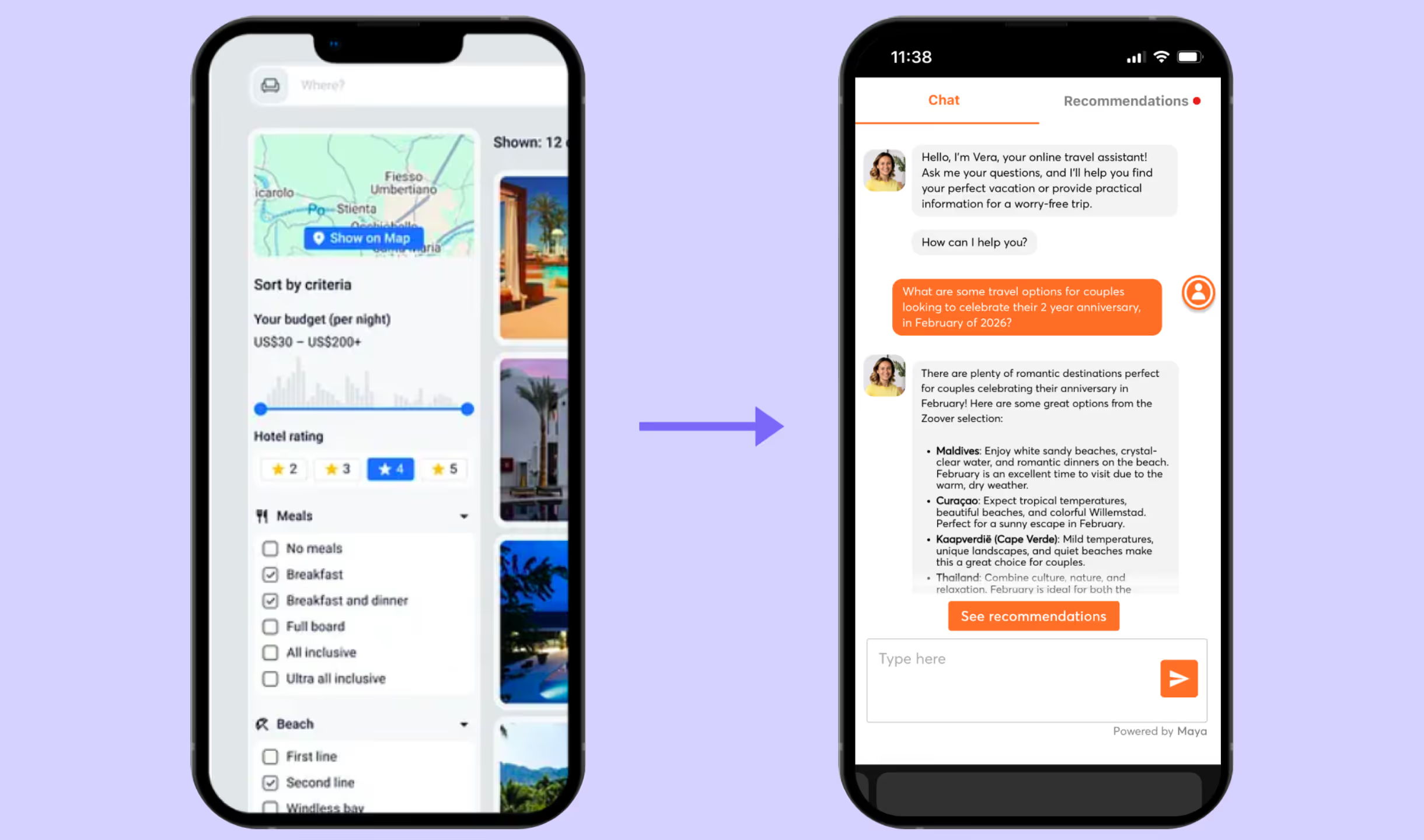
Online Travel Agencies attract billions of visits, but most travelers abandon bookings due to too many options and too little guidance. AI agents solve this by acting as digital concierge rather than simple search filters.
%20(1).jpg)



Table of content
Online Travel Agencies attract billions of visits, but most travelers abandon bookings due to decision paralysis, too many options and too little guidance. AI agents solve this by acting as intelligent travel consultants rather than simple search filters.
AI agents are transforming how Online Travel Agencies (OTAs) convert website visitors into paying customers.
- Intent recognition: the agent interprets natural-language requests (e.g., "a week in Italy with kids, great food, not crowded").
- Contextual retrieval: it queries live inventory, pricing, and reviews in real time.
- Personalized recommendations: it curates a short list and explains why each option fits.
- Ongoing assistance: it answers follow-ups, adjusts plans, and completes the booking.
Unlike traditional search experiences or scripted chatbots, an OTA AI agent acts as an intelligent, always-on digital travel consultant, understanding natural language, personalising recommendations in real time, and resolving the decision paralysis that causes up to 81% of travelers to abandon bookings before checkout (Salecycle, 2024).
This guide explains how agentic AI works for OTAs, why it outperforms legacy tools, and how Online Travel Agencies can measurably increase conversion rates.
What Is an AI Agent?
An AI agent is an autonomous software system that perceives its environment, reasons about goals, and takes actions to achieve them, without requiring step-by-step scripted instructions. In the context of travel, this means the AI can interpret complex, open-ended traveler requests, access live inventory and pricing data, and deliver curated recommendations within seconds.
This is fundamentally different from a rule-based chatbot. Here is how they compare:
CapabilityTraditional Travel ChatOTA AI AgentConversational contextLimited to keyword matchingUnderstands full intent and contextAccesses live inventory and pricingNoYes real-time pricing and availabilityKnows user preferences throughout the chatNoYesHandles multi-step tasksRarelyYesLearns and improvesNoYes
This distinction matters for OTA conversion optimization because a chatbot can only deflect simple FAQs, whereas an AI agent can guide a traveler from inspiration to confirmed booking in a single conversation.
The Core Problem:
Decision Paralysis in Online Travel Booking
The travel industry does not have a traffic problem. OTAs collectively attract billions of visits per year. The challenge is conversion.
A widely cited 2012 Google/Ipsos study found that the average traveler visited 38 websites over a period of 45 days before making a booking decision. While traveler behaviour has evolved since then, the underlying problem remains: too many options and too little guidance.
This phenomenon, known as decision paralysis in online travel booking, occurs when travelers are overwhelmed by too many options, insufficient guidance, and a lack of confidence in their choice. The result is abandoned sessions, open browser tabs, and revenue left on the table.
AI agents address this directly by reducing the cognitive load on the traveler. Instead of presenting 2,000 hotel listings, an AI agent narrows the options to three curated recommendations based on the traveler's stated (and inferred) preferences.
.jpeg)
How OTA AI Agents Work:
From Search Query to Booked Trip
The mechanics of an OTA AI agent can be broken down into four key stages:
1. Intent Recognition
The traveler communicates in natural language. For example:
"I want a week in Italy with my two kids, somewhere with good food but not too crowded."
A traditional OTA search engine would return zero results because the query does not match structured database fields. An AI agent, however, extracts multiple intent signals: destination (Italy), travel party (family with children), interests (gastronomy), and preference (off-the-beaten-path).
2. Contextual Retrieval
The agent queries the OTA's live inventory and cross-references results against the traveler's preferences. It may also factor in seasonality, reviews, and pricing trends.
3. Personalised Recommendation
Rather than a generic list, the AI agent presents a curated itinerary and explains its selection of options. This AI-powered OTA recommendation approach is what makes the interaction feel consultative rather than transactional.
4. Ongoing Assistance and Booking
The agent answers follow-up questions, adjusts the itinerary, and can initiate the booking — all within the same conversational thread. There is no need for the traveler to navigate back to a search bar.
.jpg)
Real-Time Customer Support:
Answering Deal-Breaker Questions 24/7
One of the highest-impact applications of conversational AI for OTAs is instant query resolution.
Travel purchases are high-consideration decisions, and a single unanswered question can derail a booking.
Common examples include:
- "Is the pool heated?"
- "What are the visa requirements for a layover in Singapore?"
Research suggests that more than half of online shoppers abandon a purchase if they cannot quickly find an answer to their question (Forrester Research).
For OTAs, where average order values often exceed $1,000, each lost booking is significant.
An AI agent trained on the OTA's full travel package catalog, supplier details, and destination knowledge can resolve these queries instantly.
At 2 AM on a Sunday, during peak season, or across any language. This real-time customer support travel AI capability eliminates a major source of booking friction.
Personalisation at Scale With AI
Personalisation is consistently cited as a top driver of travel conversion.
McKinsey's Next in Personalisation 2021 report found that companies excelling at personalisation generate 40% more revenue from those activities than average performers.
A standard OTA might recommend "Hotels in London" because the user searched for flights to London.
An AI agent goes significantly deeper:
- If a traveler previously mentioned an interest in history, the agent highlights proximity to the British Museum.
- If dietary preferences were shared, the agent surfaces hotels near top-rated vegan restaurants.
- If the traveler is budget-conscious, the agent proactively suggests shoulder-season dates or alternative neighbourhoods.
This OTA personalisation approach with AI works because the agent maintains conversational memory.
It builds a preference profile throughout the interaction and refines recommendations accordingly. The traveler feels understood rather than marketed to, which directly increases booking likelihood.
The Shift From Search Engines to Conversational Travel Platforms
For two decades, OTAs have functioned as sophisticated search engines: input dates, select filters, browse results. But the industry is undergoing a structural shift.
Gartner predicts that by 2027, AI-powered chat will be the primary customer service channel for approximately 25% of organizations in the travel and hospitality sector.
The reason is clear: travel is inherently emotional and complex. A search bar cannot ask clarifying questions, sense hesitation, or adapt in real time. A conversational AI for OTA platforms can.
This shift goes beyond efficiency goals. AI agents are a competitive differentiator in travel.
OTAs that deploy AI agents are positioned to deliver the high-touch service quality of a luxury travel agency with the speed and scalability of a technology platform, a combination previously impossible to achieve.
Key Takeaways: Why OTAs Should Implement AI Agents Now
- Decision paralysis is the #1 conversion killer — AI agents solve it by curating, not just listing
- 24/7 instant answers prevent high-intent travelers from bouncing to competitors
- Hyper-personalization at scale drives measurably higher booking rates
- Smart re-engagement recovers abandoned bookings with contextual, non-intrusive outreach
- Conversational interfaces are the future — early adopters gain a lasting competitive edge
The technology to solve the OTA conversion gap is here. AI agents for OTAs are not a futuristic concept; they are already deployed by forward-thinking Online Travel Agencies to increase revenue, reduce support costs, and deliver superior customer experiences.
If your OTA is ready to move from search engine to intelligent travel consultant, explore how an AI-powered travel agent like Maya can transform your conversion metrics.
How Maya, the OTA AI Agent, Helps Convert More Bookings
Maya is the AI agent for travel companies. Unlike generic agents or off-the-shelf AI chat solutions, Maya is designed specifically for the complexities of travel, where every trip involves multiple variables, emotional decision-making, and high-value transactions.
Here is what Maya does differently:
- Understands complex travel intent. Maya interprets open-ended, multi-layered requests like "a romantic anniversary trip to Greece with vineyard tours and sunset views" and translates them into curated, bookable itineraries.
- Connects to your live offerings. Maya pulls real-time availability, pricing, and package details directly from your OTA's systems, ensuring every recommendation is accurate and bookable.
- Remembers traveler preferences. Throughout the conversation, Maya builds a dynamic preference profile. If a traveler mentions a food allergy, a budget range, or a travel style, Maya factors it into every subsequent suggestion.
- Answers deal-breaker questions instantly. From visa requirements to room amenities, Maya resolves the specific doubts that cause travelers to abandon bookings -- 24 hours a day, in any language.
- Operates across channels. Whether your customers engage via your website, WhatsApp, or other messaging platforms, Maya delivers a consistent, consultative experience.
The result: OTAs using Maya reduce the gap between browsing and booking by providing every traveler with a personalised, frictionless path to purchase -- at scale, without increasing headcount.
Ready to see the difference? Get in touch to see Maya in action.
New mobile apps to keep an eye on
Auctor purus, aliquet risus tincidunt erat nulla sed quam blandit mattis id gravida elementum, amet id libero nibh urna nisi sit sed. Velit enim at purus arcu sed ac. Viverra maecenas id netus euismod phasellus et tempus rutrum tellus nisi, amet porttitor facilisis aenean faucibus eu nec pellentesque id. Volutpat, pellentesque cursus sit at ut a imperdiet duis turpis duis ultrices gravida at aenean amet mattis sed aliquam augue nisl cras suscipit.
- Commodo scelerisque convallis placerat venenatis et enim ullamcorper eros.
- Proin cursus tellus iaculis arcu quam egestas enim volutpat suspendisse
- Sit enim porttitor vehicula consequat urna, eleifend tincidunt vulputate turpis
What new social media mobile apps are available in 2022?
At elit elementum consectetur interdum venenatis et id vestibulum id imperdiet elit urna sed vulputate bibendum aliquam. Tristique lectus tellus amet, mauris lorem venenatis vulputate morbi condimentum felis et lobortis urna amet odio leo tincidunt semper sed bibendum metus, malesuada scelerisque laoreet risus duis.

Use new social media apps as marketing funnels
Ullamcorper pellentesque a ultrices maecenas fermentum neque eget. Habitant cum esat ornare sed. Tristique semper est diam mattis elit. Viverra adipiscing vulputate nibh neque at. Adipiscing tempus id sed arcu accumsan ullamcorper dignissim pulvinar ullamcorper urna, habitasse. Lectus scelerisque euismod risus tristique nullam elementum diam libero sit sed diam rhoncus, accumsan proin amet eu nunc vel turpis eu orci sit fames.
- Eget velit tristique magna convallis orci pellentesque amet non aenean diam
- Duis vitae a cras morbi volutpat et nunc at accumsan ullamcorper enim
- Neque, amet urna lacus tempor, dolor lorem pulvinar quis lacus adipiscing
- Cursus aliquam pharetra amet vehicula elit lectus vivamus orci morbi sollicitudin
“Sit enim porttitor vehicula consequat urna, eleifend tincidunt vulputate turpis, dignissim pulvinar ullamcorper”
Try out Twitter Spaces or Clubhouse on iPhone
Nisi in sem ipsum fermentum massa quisque cursus risus sociis sit massa suspendisse. Neque vulputate sed purus, dui sit diam praesent ullamcorper at in non dignissim iaculis velit nibh eu vitae. Bibendum euismod ipsum euismod urna vestibulum ut ligula. In faucibus egestas dui integer tempor feugiat lorem venenatis sollicitudin quis ultrices cras feugiat iaculis eget.
Try out Twitter Spaces or Clubhouse on iPhone
Id ac imperdiet est eget justo viverra nunc faucibus tempus tempus porttitor commodo sodales sed tellus eu donec enim. Lectus eu viverra ullamcorper ultricies et lacinia nisl ut at aliquet lacus blandit dui arcu at in id amet orci egestas commodo sagittis in. Vel risus magna nibh elementum pellentesque feugiat netus sit donec tellus nunc gravida feugiat nullam dignissim rutrum lacus felis morbi nisi interdum tincidunt. Vestibulum pellentesque cursus magna pulvinar est at quis nisi nam et sed in hac quis vulputate vitae in et sit. Interdum etiam nulla lorem lorem feugiat cursus etiam massa facilisi ut.



.svg)