

Conversational AI Agent For Online Travel Agencies
Personalised Answers for More Bookings
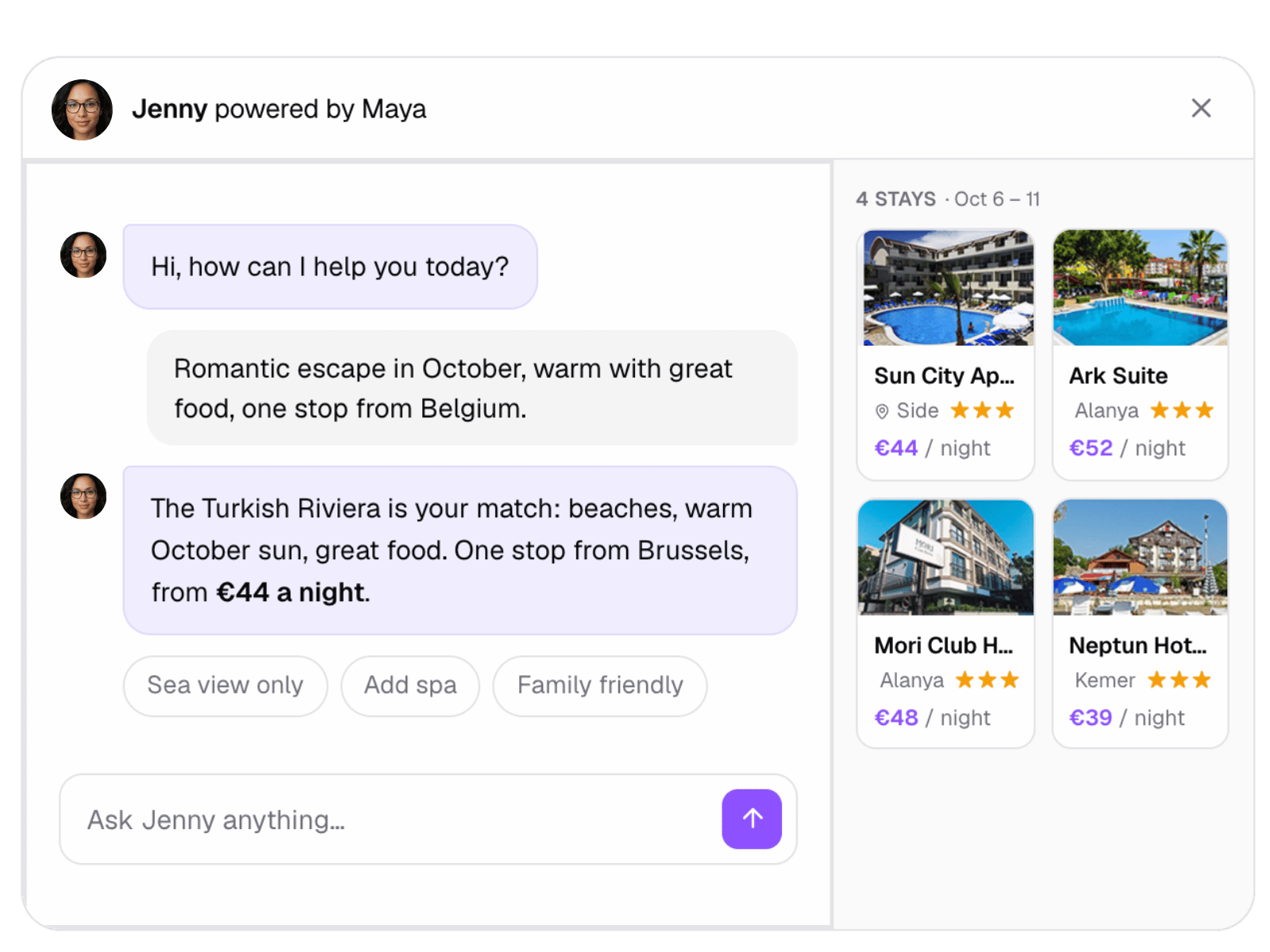
Maya-powered agents talk to travellers in their own words, narrow your catalogue to a few relevant trips, and guide them towards booking faster.
+50%
Engagement rate
+30%
Bookings uplift
3x
More conversions



.avif)













Many OTAs Face Similar Challenges



How Maya Lifts Conversion Rates on High-Traffic OTA Websites

.png)



Online Travel Agencies Are Already Using Maya
Calculate ROI & Bookings Uplift
Run the numbers, and see how much a conversion lift is worth on your traffic.
Got Questions?
Find answers to the most commonly asked questions about conversational AI agents working for OTAs.
Why do OTAs use Maya?
OTAs use Maya to build their own AI agent with their name, brand, and tone of voice, instead of bolting a generic chatbot onto their site. For example, at Zoover, travellers talk to "Vera", not to Maya. Because the agent is trained exclusively on the OTA's own catalogue, reviews, content and real-time pricing, it sounds like the brand and only recommends trips the OTA actually sells. This means accurate, on-brand answers with 99%+ answer relevance and no invented products.
What results do OTAs see when using a conversational AI agent software built for travel like Maya?
OTAs using Maya typically see higher booking conversion, lower bounce, better trip discovery, and 24/7 multilingual support at scale, because Maya replaces filter-heavy browsing with an interactive, chat-based trip-finding experience that reduces choice paralysis. Zoover’s Maya-powered agent “Vera” delivered 3x higher conversion for travellers who interacted with it and handled around 50% of queries instantly with no human intervention (Zoover A/B test, 2025).
How can an OTA use a conversational AI agent solution to increase booking conversion?
A conversational AI agent for travel, like Maya, increases an OTA's visitor-to-booking and engagement rates by replacing static, filter-based search with intent-aware, conversational guidance that moves travellers from "just browsing" to booking a trip.
Does a conversational AI agent software solution managing traveller chats like Maya deliver a positive ROI for OTAs?
Yes, most OTAs see positive ROI within the first quarter. Because OTAs run at high traffic volumes, even a small conversion lift produces a fast, provable return. In Zoover’s case, one of the leading OTAs in the Netherlands, an increase in visitor-to-booking conversion translated into additional revenue of six figures, on top of lower cost-to-serve from automating repetitive enquiries. Maya combines higher revenue (more bookings from existing traffic) with lower costs (fewer repetitive emails, chats, and WhatsApp messages handled manually), and most OTAs see positive ROI within the first quarter.
How does Maya solve decision paralysis and choice overload for online travel agencies?
Decision paralysis is the #1 conversion barrier for most OTAs; up to 81% of travellers abandon bookings before checkout because too many options make choosing difficult, according to a 2024 SaleCycle report. Maya reduces booking abandonment by acting as a personal travel advisor. It interprets conversational, intent-rich queries (e.g. “somewhere warm and quiet for a honeymoon in November”), narrows thousands of options down to a few relevant trips, and guides the traveller directly to the right booking page, instead of leaving them to filter and tab-switch until they give up.
Can Maya scale to high-traffic OTAs without adding headcount?
Yes. Maya is built to absorb high seasonal enquiry volumes without a linear increase in staff. It answers up to 90% of traveller enquiries instantly and reduces repetitive support tasks by 80%, so teams can focus on complex or high-value cases. It provides 24/7 coverage, capturing after-hours and international demand that would otherwise be lost, and escalates seamlessly to a human via Slack or Microsoft Teams when a conversation needs one, with full context preserved.
Which channels and languages does Maya support for OTAs?
Maya deploys across website chat, WhatsApp, Instagram, Facebook Messenger, and email, and integrates with Slack and Microsoft Teams for AI-to-human handover. All channels share the same context, tone of voice, and knowledge base. Maya supports 50+ languages, automatically detecting and replying in the traveller’s language — important for OTAs serving international audiences where instant, native-language answers build trust and capture conversions that would otherwise hesitate.
How is Maya different from a generic AI chatbot (e.g. Zendesk or Intercom) for online travel agencies?
Unlike horizontal, ticket-first chatbots (e.g. Zendesk or Intercom), Maya is a travel-native AI agent that understands trips, packages, availability, and booking intent out of the box. It is trained only on each OTA’s own catalogue, content, and real-time pricing, delivering 99%+ answer relevance. It recommends trips visually, supports booking-oriented channels like WhatsApp, and is deployed under the OTA’s own brand (for example, “Vera” at Zoover). The result is a conversion engine, not just a support deflection tool.
Why do travellers abandon bookings on OTA websites and how does a conversational AI agent like Maya fix it?
Online travel agencies' (OTAs) booking abandonment is often caused by choice paralysis and overwhelming options on the traveller's side, and friction-heavy conversion mechanisms such as long forms, rigid filters, and multi-step booking journeys on the OTA side. Conversational AI agents for OTAs like Maya resolve choice paralysis through natural-language conversations. Travellers describe their needs, Maya asks relevant follow-up questions, narrows the OTA’s catalogue to a few suitable options and guides each traveller to the most relevant booking page.

.svg)