

Maya vs Zendesk: The Best AI Agent for Travel Companies in 2026
If you’re evaluating AI agent solutions for your travel business in 2026, the conversation almost always narrows to a few names.




If you’re evaluating AI agent solutions for your travel business in 2026, the conversation almost always narrows to a few names.
Maya and Zendesk might be on your shortlist. They sit on opposite ends of the spectrum: a vertical AI agent built for travel operators on one side, and a horizontal customer-service platform with a “travel” intent pack on the other.
We’ll explore the two solutions, focusing on what they offer travel companies, what their case studies show, and where each tool fits.
Maya: the AI agent built for travel
Maya is an AI agent for travel companies, designed for how tour operators, experience providers, travel agencies, OTAs and DMCs really work.
What that looks like in practice:
- Travel-native data layer. Itineraries, suppliers, destinations, seasonality and pricing are first-class concepts, not custom fields shoehorned into a CX schema.
- Full-funnel agent, not a deflection bot. Lead capture, traveller qualification, itinerary drafting, FAQ answering, and post-booking support, all in one agent.
- Omnichannel view. Chats on the client’s website, WhatsApp business chat, and social profiles including Instagram and Messenger, in the languages your travellers actually use, 24/7.
- Commercial outcomes. Maya is measured on bookings influenced, qualified leads, response rate and conversion - the metrics travel businesses actually run on.
For a DMC building bespoke itineraries, a tour operator scaling first-touch-to-sale, or an OTA managing pre-sales questions in five languages, Maya answers a fundamentally different brief than that of a customer support tool.
Maya’s live customer cases:
- Travelbase: AI agent “Atlas” drafts up to 82% of inbound email replies (reviewed in around 30 seconds vs 4+ minutes manually), delivering up to 30% more bookings and an estimated €18,000/month in cost savings.
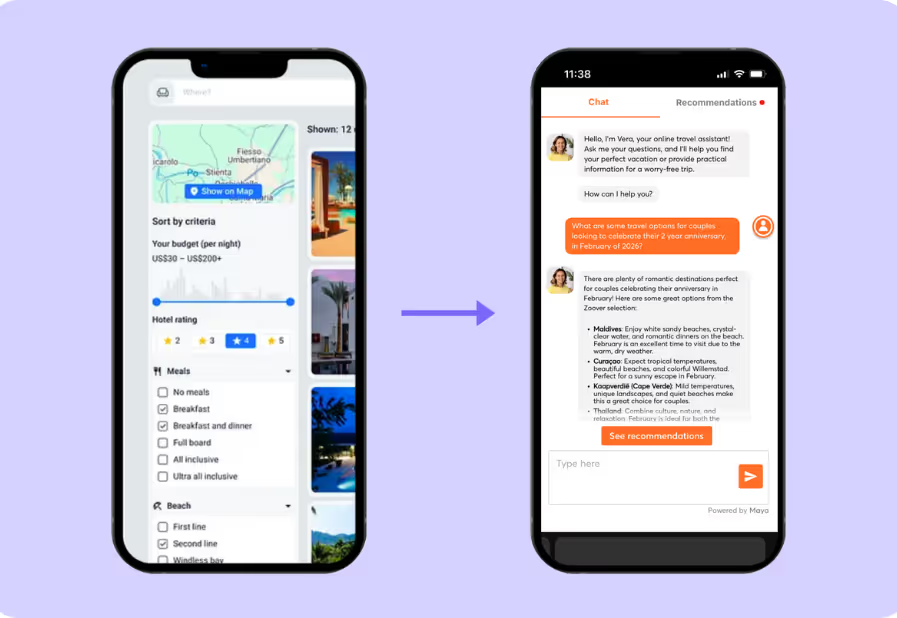
- Zoover: “Vera” delivers 3–5x higher conversion for travellers who engage with it and handles half of all incoming queries instantly, without humans having to spend time on them.
- Best Arctic: named AI persona “Maria” handles multilingual support 24/7, guides high-intent visitors to booking pages, and opened an unexpected B2B channel with partner tour operators.
Travel companies across 20 countries use Maya daily to answer 90% of traveller enquiries instantly, without human intervention, in 50+ languages, so this is production-grade AI running live commercial deployments today, not an unproven bet.
Zendesk for travel companies
Zendesk is the most established customer-service platform in the world, used by 100,000+ companies and increasingly positioned as an “AI-first” service platform.
To understand whether Zendesk is the right AI agent for your travel business, you need to look past the marketing and into the actual product, pricing, and what Zendesk’s own travel customers say.
What Zendesk actually offers travel companies
Zendesk’s travel and hospitality stack is built around four product layers:
- Zendesk Suite: the core ticketing and omnichannel platform (email, messaging, voice, chat, social, help centre) sold per agent per month.
- Zendesk AI Copilot: an in-agent assistant that summarises tickets, drafts replies, suggests macros and translates conversations.
- Advanced AI add-on: intent detection, smart triage, macro suggestions and AI-powered insights, sold as an additional per-agent fee.
- Zendesk Resolution Platform & AI Agents: autonomous AI agents pre-trained on 18B+ CX interactions, with industry intent packs (including travel and hospitality) and per-resolution pricing.
It’s a serious platform with active implementations. The honest question for travel companies isn’t whether Zendesk works - it does - but whether it’s the right type of product for your business.
Does Zendesk work for travel companies?
Zendesk publishes a strong roster of travel and hospitality customer stories. They’re worth reading carefully as they reveal exactly where Zendesk wins and where it’s being used as ticketing infrastructure rather than as a travel-native AI agent.
The common thread across Zendesk’s travel case studies is clear: they’re overwhelmingly large enterprises using Zendesk as omnichannel ticketing infrastructure with AI productivity features layered in.
And where AI is the headline (TravelPerk, Serko), it shows up mainly as agent-side productivity and support-ticket resolution - ticket summarisation, translation, drafting and deflecting inbound tickets.
Even Serko, which has deployed Zendesk’s autonomous AI Agents and automated roughly a third of resolutions in its first month, is using them to resolve support tickets at scale, not to qualify travellers and drive bookings off its own itineraries and supplier inventory.
That’s exactly the gap Maya is built to fill.
Where Zendesk falls short for travel SMBs
Zendesk’s own success stories tell you who it’s built for, enterprise-level companies. For everyone else - independent DMCs, mid-sized tour operators, boutique OTAs, niche travel agencies and experience providers, there are product-fit issues that might come up:
- Generic AI, not travel-native. Even with travel and hospitality intent packs, Zendesk AI has no concept of itineraries, suppliers, seasonality, booking flows or destination-level inventory. It’s tuned for support tickets, not for converting a “Honeymoon in Kenya in September?” enquiry into a qualified lead.
- AI resolution that often underperforms out of the box. In a published travel and hospitality analysis (MyAskAI), Zendesk’s AI resolved only around 23% of queries out of the box, before teams added a different AI layer to reach roughly 76%. Pushing Zendesk AI to higher resolution generally means extra knowledge-base work and added tooling cost.
- Heavier setup before strong autonomous performance. Zendesk markets fast, day-one setup, but getting its autonomous AI to perform well typically means building and maintaining a knowledge base, training intents, integrating systems and managing change. For a lean tour operator, that ramp-up is real work before the AI reliably pays for itself.
Bottom line: Zendesk is excellent enterprise CX infrastructure with strong AI productivity features. It is not, by design, a travel-native AI agent.
Maya vs Zendesk side-by-side comparison
When Maya fits, when Zendesk fits
Choose Maya if you:
- Are a DMC, tour operator, travel agency, travel seller or mid-market OTA.
- Want AI that understands itineraries, suppliers and destinations, not just tickets.
- Need to capture and qualify leads on web, WhatsApp and email, 24/7, in multiple languages.
- Want measurable commercial outcomes (bookings, qualified leads, conversions) in weeks, not quarters.
- Don’t want to build and maintain a 6–18 month enterprise CX programme to justify your AI spend.
Choose Zendesk if you:
- Operate a large airline or travel-tech platform with a 100+ seat CX team.
- Already run a heavy ticketing stack and need omnichannel SLA enforcement, workforce management and case-routing.
- Want AI primarily to support agents (Copilot, summarisation, translation) rather than to convert and sell more trips.
- Have the budget for $100K+/year in licences (Suite + Copilot + Advanced AI, per Zendesk’s published 2026 pricing) and the patience for a 12–24 month rollout to ROI.
The takeaway
Maya vs Zendesk isn’t really a like-for-like fight, it’s a category choice. Zendesk is best-in-class enterprise CX infrastructure with strong AI productivity features, used by airlines and travel-tech giants like LATAM Airlines, TravelPerk, Lonely Planet and Serko. Maya is the only AI agent purpose-built for travel operators, designed to sell, qualify and serve travellers across web, WhatsApp and email in weeks, not quarters.
If you’re a travel company and you want AI that speaks your language - itineraries, suppliers, travellers, conversions - Maya was built for you.
👉 See Maya in action for your travel business.
FAQ: Maya vs Zendesk for travel companies
Is Maya a Zendesk alternative for travel agencies? Yes - for DMCs, tour operators, travel sellers and OTAs that want a travel-native AI agent rather than a generic CX ticketing suite, Maya is the closest direct alternative to Zendesk. For very large CX organisations that genuinely need omnichannel ticketing at scale, Maya can also sit on top of Zendesk rather than replace it.
Which Zendesk travel case studies are most relevant? The most-cited public Zendesk travel customers are LATAM Airlines (90% employee satisfaction with Zendesk Suite across 30K+ employees), TravelPerk (Zendesk AI in CX for global business travel), Lonely Planet (CX and customer-insights), and Serko Limited (AI summarisation across 4M+ bookings/year). All four are large, established travel-tech or transportation enterprises - not the typical DMC or tour-operator profile.
How much does Zendesk AI really cost in 2026? Realistic 2026 pricing is $115–$209/agent/month for Suite + Copilot, +$50/agent/month for the Advanced AI add-on, and $1.50–$2.00 per automated resolution for autonomous AI Agents. A 25-agent travel CX team typically lands around $77K–$93K+/year in licences alone, before implementation and per-resolution fees.
Why is Zendesk AI’s out-of-the-box resolution rate so low for travel? Independent case studies put Zendesk AI’s travel and hospitality resolution rate at around ~25% out of the box, because its intent packs and knowledge models are generic CX content, not grounded in your itineraries, suppliers and booking inventory. Teams that reach 70–79% typically add extra AI layers and significant knowledge-base work on top of Zendesk.
Can Maya and Zendesk work together? Yes. For large travel organisations already running Zendesk Suite, Maya can be deployed as the traveller-facing AI agent on web, WhatsApp and email, while Zendesk continues to handle agent-side ticketing, SLA management and workforce tools.
Who is Maya best for? Maya is best for travel companies - DMCs, tour operators, travel sellers, travel agencies and mid-sized OTAs - that want an AI agent grounded in their own travel product, deployed in weeks, and measured on bookings and qualified leads rather than ticket-deflection rate.
Continue reading








.svg)